The wind howls across the rocky plateau of Dmanisi, Georgia. Beneath the ruins of a medieval town, the earth holds a secret far older than any castle. For decades, this site has guarded a puzzle etched in bone and stone.
What if everything we thought we knew about the first daring journey of our ancestors out of Africa was wrong? What if the family that took that first, monumental step was far stranger and more diverse than we ever imagined?
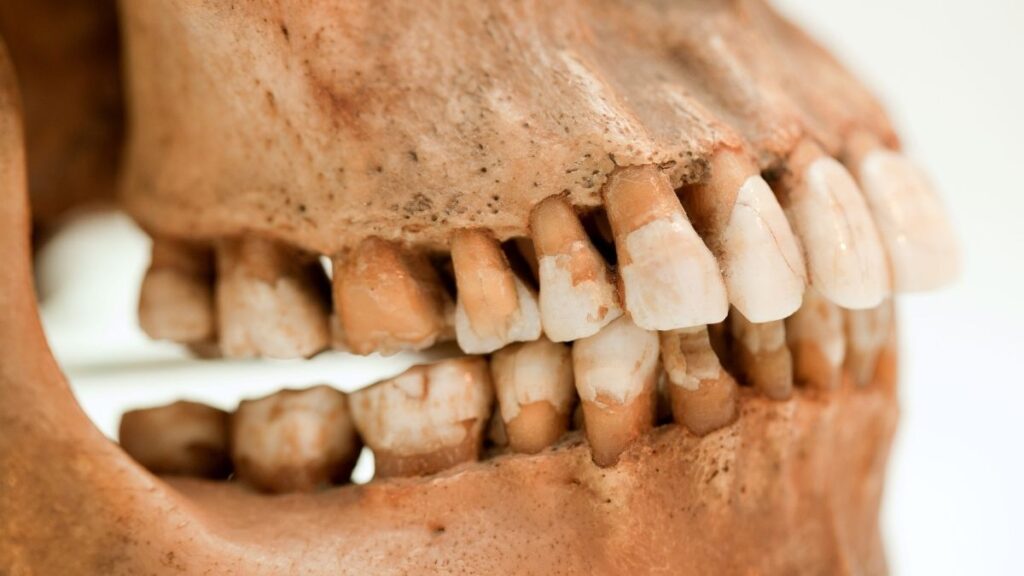
A revolutionary new study has cracked open that ancient mystery. Not with a flashy skull, but with a quiet, meticulous analysis of 538 fragments of enamel and root. These ancient teeth are now telling a story that is rewriting the first chapter of the human odyssey.
DMANISI: THE CROSSROADS OF PREHISTORY
Nestled in the Caucasus, Dmanisi is a time capsule like no other. It is widely considered the site of the oldest hominin fossils outside of Africa, dating back a staggering 1.8 million years.
For years, it has been the crown jewel of paleoanthropology. The site yielded skulls, jaws, and stone tools. It painted a picture of a small band of early humans, classified as Homo erectus, who had ventured over a million miles from their evolutionary homeland.
But a nagging question divided experts. The fossils found together showed shocking variation. Some had robust, heavy brows and large jaws. Others were more gracile and small.
This sparked a fierce, decades-long debate. Were the Dmanisi hominins one single, highly variable population? Or were two different human species sharing this ancient landscape?
THE ASTONISHING FIND: A DENTAL DETECTIVE STORY
The new research took a forensic approach. Scientists turned away from the dramatic skulls and focused on the unsung heroes of archaeology: teeth.
Teeth are time capsules. They are incredibly durable and their morphology is a direct window into genetics, diet, and species identity. The team conducted a microscopic-level analysis of 538 dental specimens from Dmanisi.
They measured every cusp, groove, and ridge. They compared them to a global database of hominin teeth, from African Australopithecus to later Asian Homo erectus.
The findings were nothing short of mind-blowing.
The evidence pointed decisively toward two distinct groups. The dental signatures clustered into two separate patterns that could not be explained by simple differences between males and females of one species. The variations were too extreme.
The “two species” theory had just gained powerful new evidence.
WHAT THE TEETH REVEAL: A LOST CHAPTER OF DIVERSITY
This discovery shatters a simplistic view of early human migration. It suggests that the journey “Out of Africa” was not a single-species exodus.
Instead, the gateway to Eurasia was a bustling, dynamic zone. Multiple kinds of early humans likely coexisted or succeeded one another at Dmanisi over thousands of years.
The implications are profound. It reveals an era of experimentation and diversity at the dawn of human expansion. Our family tree in Eurasia was bushier and more complex from the very beginning.
But the dental analysis revealed an even more startling secret.
THE SHOCKING TWIST: A GHOST LINEAGE EMERGES
As scientists peered closer at the dental landscape, they found anomalies. Some dental features in the Dmanisi collection didn’t look like classic Homo erectus at all.
They bore a striking, archaic resemblance to something much older. They echoed the teeth of Australopiths—the more ape-like, bipedal ancestors like “Lucy” (Australopithecus afarensis) who lived in Africa millions of years earlier.
This is the bombshell.
It suggests a previously unknown, earlier wave of migration. A group with more primitive traits may have left Africa before the classic Homo erectus, perhaps even before 2 million years ago.
These pioneers may have reached places like Dmanisi, leaving their genetic and anatomical signature in the population. They were a ghost lineage, a forgotten first attempt at conquering the world.
GLOBAL IMPLICATIONS: REDRAWING THE HUMAN MAP
This study forces a complete re-evaluation of the human story. Dmanisi is no longer just the story of Homo erectus arriving in Eurasia.
It is now a layered archive of deeper history. The site becomes a crucial benchmark, proving that the human spread across the globe was a messy, multi-species affair.
It connects the dots to other puzzling, fragmentary fossils across Asia that have never quite fit the erectus mold. Could they be remnants of this earlier, elusive wave?
The narrative of a linear, triumphant march of a single “advanced” species out of Africa is officially obsolete. Our origins were a tangled web of diversity, competition, and multiple courageous dispersals into the unknown.
WHAT THIS MEANS FOR HISTORY: A NEW DAWN FOR HUMAN ORIGINS
The story of Dmanisi’s teeth is a masterclass in scientific revelation. It proves that the smallest fragments can hold the biggest secrets. By looking past the obvious, researchers have uncovered a lost world.
We now understand that Eurasia was a melting pot almost from the start. The “first Europeans” were likely a mixed community, representing different chapters of human evolution.

This discovery opens a thrilling new frontier. It sends archaeologists back to the drawing board, re-examining old finds with new eyes. The hunt is now on for more evidence of this mysterious, early pulse of hominins who looked toward the horizon and left Africa behind, changing the destiny of our planet forever.
5 IN-DEPTH FAQs
1. How was the Dmanisi site discovered?
The site was found entirely by accident. In the 1980s, archaeologists excavating a medieval cellar beneath Dmanisi’s ruins unearthed the bones of an extinct saber-toothed cat. This led to a full-scale paleontological dig, which quickly revealed stone tools and, in 1991, the first ancient hominin jaw. The medieval ruins had perfectly preserved a prehistoric treasure trove beneath them.
2. Why are teeth so important for identifying different species?
Teeth are the hardest substance in the human body and fossilize exceptionally well. Their shape, size, and internal structure are under strong genetic control and are less influenced by an individual’s life activities than bones. This makes them a highly reliable “blueprint” for distinguishing between species and understanding evolutionary relationships.
3. If there were two species, what were they likely to be?
The study strongly supports the presence of Homo erectus at Dmanisi. The second species remains more mysterious. Based on the primitive dental traits, it could be an as-yet-unnamed early form of Homo, or even a late-surviving, geographically far-flung descendant of an Australopithecus-like ancestor. More complete fossils are needed to give it a formal name.
4. Does this mean humans left Africa more than once?
Absolutely. This study provides powerful evidence for at least two major dispersal events before 1.8 million years ago. The first, earlier wave carried more primitive, australopith-like traits. The second, later wave involved the more advanced, tool-making Homo erectus. This “multiple exodus” model is becoming the new scientific consensus.
5. How does this change our view of Homo erectus?
It contextualizes Homo erectus not as a lone pioneer, but as a successor and likely competitor. Homo erectus may have entered a landscape already inhabited by other hominins. This forces us to see them as part of a complex ecological web, interacting with—and perhaps out-competing—other human species in the struggle for survival in new continents.