

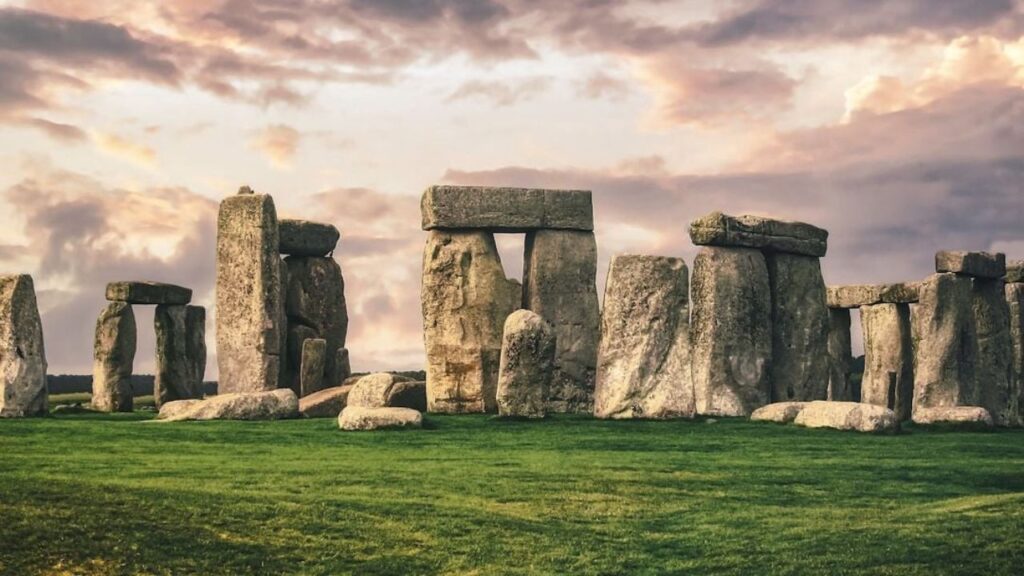
For over a century, a convenient theory has lingered on the icy fringes of archaeology: perhaps Stonehenge wasn’t built by ancient ingenuity, but by ancient glaciers. That the iconic bluestones were merely glacial debris, dumped by a retreating ice sheet. It was a theory that, in its way, diminished one of humanity’s greatest prehistoric achievements. Now, that theory is dead. Annihilated not by shovels, but by science. A landmark peer-reviewed study has delivered a verdict written in microscopic minerals: People did this. The stones of Stonehenge stand not as geological accidents, but as permanent monuments to Neolithic ambition.
The Astonishing Find: A Forensic Case Against Ice
The debate has simmered for decades. The smaller “bluestones” of Stonehenge’s inner circle were geochemically traced to the Preseli Hills in Wales—225 kilometers away. The massive Altar Stone hailed from northern England or Scotland, a staggering 500-kilometer journey. The glacial transport theory offered a seductive shortcut: maybe the ice age did the heavy lifting.
The Micro-Mineral Fingerprint
An international team led by researchers Anthony Clarke and Christopher Kirkland took a revolutionary approach. They turned to forensic geology. Their study, published in Communications Earth & Environment, analyzed over 700 microscopic grains of zircon and apatite—incredibly durable minerals—from rivers surrounding Salisbury Plain.
The logic was brilliant. If glaciers from Wales or Scotland had scraped across this landscape, they would have pulverized bedrock and left a telltale “fingerprint” of these ancient minerals in the local river sediments. It would be a permanent, microscopic snow of evidence.
“While previous research cast doubt, our study applies cutting-edge mineral fingerprinting to trace the stones’ true origins,” said the authors. They used radioactive decay rates to date each tiny grain, building a map of what rocks had truly passed through the area over millennia.
The Verdict: An Empty Glacial Record
The results were definitive. The mineral fingerprint in Salisbury Plain’s rivers showed no match for the distinctive ancient rocks of Wales or Scotland. The glacial signature was utterly absent. The ice sheets of the last ice age simply never reached that far south. The path was clear. No ice. No accidental delivery. The stones had only one possible mode of transport: deliberate, concerted human effort.
Global Implications: A Neolithic Mindset Revolutionized
This isn’t just a technical correction. It’s a paradigm shift that ripples across our understanding of prehistoric Europe. By disproving the glacial theory, the study elevates Stonehenge from a possible coincidence to a certain masterpiece of logistics, social organization, and spiritual will.
The Scale of Ambition Recalibrated
The confirmed distances are mind-blowing. Transporting multi-ton bluestones 225 km from Wales over Neolithic terrain—rivers, forests, hills—was a generational undertaking. The possible 500-km journey of the Altar Stone from Scotland becomes an almost mythical feat. This was not a local building project. It was a pan-British endeavor, likely requiring alliances, shared belief systems, and a coordinated society with astonishing engineering prowess.
“This gives us further evidence that the monument’s most exotic stones were deliberately selected and transported,” the researchers concluded. The choice of stone was intentional. The journey was purposeful. Stonehenge’s very composition was an act of profound cultural and spiritual expression, linking the sacred plain to distant, powerful landscapes.
What This Means for History: The Narrative Rebuilt
The death of the glacial theory rebuilds Stonehenge’s story from the ground up. It forces us to replace maps of ice flows with maps of human pathways, trade networks, and social connections. It turns our gaze from climate to culture.
The Questions That Now Scream for Answers
How? Without glaciers as a scapegoat, the “how” becomes electrifying. Were the stones dragged on sledges? Rolled on log rails? Partially transported by water along rivers and coasts? Each hypothesis now carries greater weight.
Why These Stones? The intentional selection is key. Did the Preseli Hills hold spiritual significance? Were the stones believed to possess power? Their specific geology was part of the message.
What Level of Society? This scale of enterprise implies a highly organized, likely stratified society with leaders, engineers, and the ability to mobilize and sustain a large workforce over years, if not decades.
Stonehenge now stands even taller in the human story. It is no longer a monument that might have been built by people. It is a monument that could only have been built by people. It is a testament to a drive so powerful it moved mountains, stone by stone, across a continent. The new science hasn’t just solved a mystery; it has restored a wonder to its rightful creators.
5 In-Depth FAQs
1. What exactly was the “glacial transport theory”?
It was the hypothesis that Stonehenge’s smaller bluestones and Altar Stone were not moved by humans, but were instead deposited on Salisbury Plain by glaciers during the last Ice Age (approximately 20,000 years ago). Proponents suggested the stones were erratics—rocks carried and dropped by ice sheets—that Neolithic builders simply found nearby and used, drastically reducing the perceived scale of their achievement.
2. How does the new “mineral fingerprinting” method work?
Researchers analyzed tiny, resistant minerals like zircon and apatite from local river sands. Each grain carries a unique age signature based on radioactive decay. By compiling the ages of hundreds of these grains, they created a precise profile of the ancient rock sources that have eroded into the region over millions of years. The absence of grains matching the Welsh/Scottish bluestone sources proved those rocks never naturally eroded there, meaning glaciers never brought them.

3. If not by glacier, how did the stones get to Stonehenge?
While this study confirms human transport, the exact method remains a topic of active research and experiment. The leading theory involves a combination of land and water transport: using wooden sledges, rollers, and ropes to drag stones overland to waterways, then floating or hauling them on rafts along rivers and the coast, before a final overland journey to Salisbury Plain. Experimental archaeology projects have demonstrated the feasibility of these methods.
4. Why does disproving a 100-year-old theory matter so much today?
It fundamentally changes the narrative of human prehistory. Attributing Stonehenge to glaciers framed early societies as opportunistic. Proving human transport frames them as visionary, organized, and capable of mega-engineering. It elevates our ancestors’ technological and social sophistication, forcing a rewrite of textbooks and museum displays to emphasize agency over accident.
5. What’s the next big question for Stonehenge researchers?
The focus now intensifies on the “cultural why.” With the “how” (human transport) solidified, researchers are diving deeper into the motivations. Why were those specific quarries in Wales and Scotland chosen? What was the symbolic or religious power of those stones? The quest is to understand the belief system that was powerful enough to motivate such an unimaginable physical effort.