

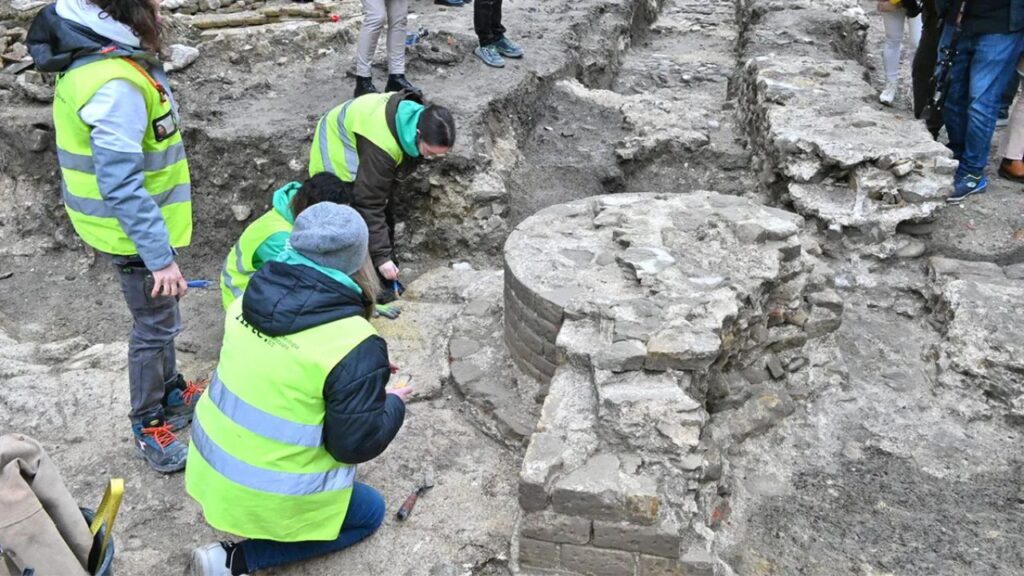
Archaeologists in Italy have uncovered what may be the first physical architectural evidence directly connected to Vitruvius, the legendary Roman engineer widely regarded as the “Father of Architecture.” The monumental discovery was made in the historic city of Fano, offering rare confirmation of structures long described only in ancient texts.
The remains belong to a massive Roman basilica, a type of public building that, in ancient times, served administrative and judicial purposes rather than religious ones. Before Christianity spread across the Roman Empire, basilicas functioned as civic centers—used as courthouses, meeting halls, and spaces for official work.
A Monumental Civic Building From Ancient Rome
According to Italian archaeologists, the structure uncovered in Fano was rectangular in shape and supported by 14 large columns, reflecting a sophisticated and highly organized architectural design. This layout closely aligns with descriptions found in Vitruvius’s own writings, making the discovery historically extraordinary.
For centuries, scholars studied Vitruvius’s work without ever locating a building that could be definitively attributed to him. While his theories influenced architecture for over two millennia, no physical structure had been confidently linked to the man himself—until now.
Why Vitruvius Remains One of History’s Most Influential Thinkers
Vitruvius was born more than 2,100 years ago, around the first century BC. He authored De Architectura, a groundbreaking work that remains the world’s oldest known book on architecture and engineering. The treatise consists of ten volumes detailing everything from house construction and machinery to city planning and structural harmony.
His principles emphasized proportion, balance, durability, and beauty—ideas that continue to shape modern architecture and engineering. Even today, Vitruvius’s theories are taught in architecture schools around the world.
The Hidden Blueprint Behind Modern Engineering
One of the most famous artistic works inspired by Vitruvius is the “Vitruvian Man,” created by Leonardo da Vinci. The iconic image of a man standing inside a circle and square was directly based on Vitruvius’s ideas about human proportions and geometry.
Vitruvius’s influence extended far beyond the Renaissance. Architects such as Andrea Palladio and Christopher Wren followed his principles while designing some of the world’s most iconic buildings. His ideas formed the backbone of what is now considered classical and modern architectural theory.
Archaeologists Say the Evidence Is “Exceptionally Precise”
Andrea Pessina, a senior official from Italy’s archaeological department, stated that the underground structure discovered in Fano matches Vitruvius’s descriptions with remarkable accuracy. He explained that archaeological findings often leave room for doubt, but the precision of this basilica’s layout significantly reduces uncertainty.
The dimensions, column placement, and overall design correspond almost perfectly with what Vitruvius described in De Architectura, strongly suggesting a direct connection to the famed architect.
A Discovery That Will Echo Through Generations
Italian Culture Minister Alessandro Giuli described the discovery as “sensational,” emphasizing that it is a find future generations will continue to discuss and study. Meanwhile, Fano Mayor Luca Serfilippi called it “the discovery of the century,” noting that scholars had searched for this basilica for hundreds of years.
Archaeologists plan to continue excavations at the site, with hopes of uncovering additional structures and eventually opening the area to the public. If further evidence supports current findings, the Fano basilica could become one of the most significant Roman archaeological discoveries in modern times.