




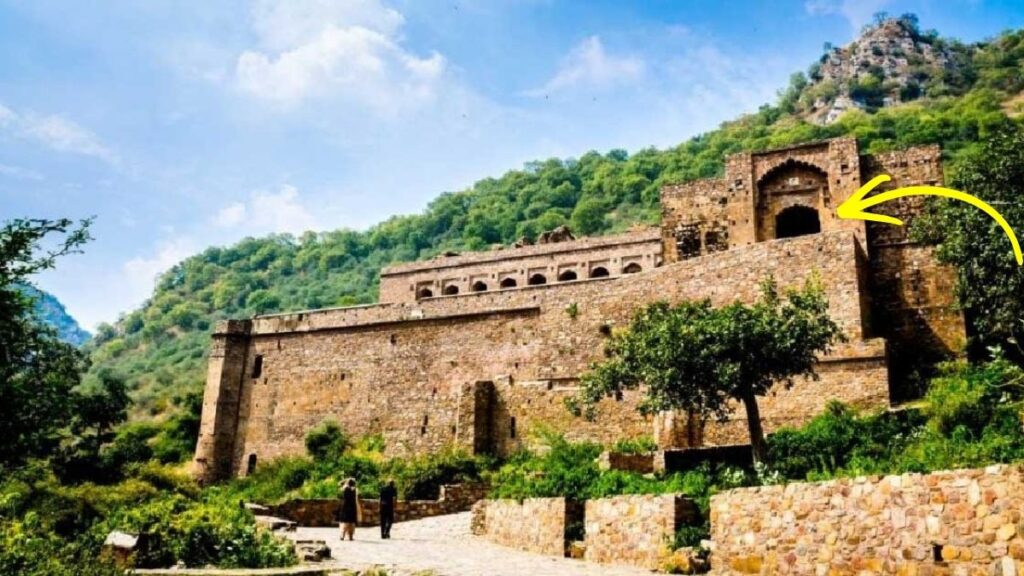
Bhangarh Fort — India’s Most Haunted Place: There are ruins that speak of fallen empires, and then there are ruins that whisper of curses. The drive to Bhangarh Fort in Rajasthan is a journey into a liminal space, where the line between a documented past and an indelible folklore blurs into a single, chilling atmosphere. You don’t just visit Bhangarh; you pass through its lingering funeral procession—a village of living people occupying the carved, crumbling shells of havelis, their present-day lives framed by doors locked with the rust of centuries.
Built in 1573, this was no forgotten outpost. It was a princely gift from a Rajput king to his son, sibling to the mighty Man Singh I of Amber. Yet, today, it is officially mandated as a place too perilous to enter between sunset and sunrise. Is it the ghost of a princess wronged by a lovelorn tantrik, or the wrath of an ascetic whose shadow was violated? Or is the truth, as it often is, etched more plainly in the stones of its deserted sister-fort, Ajabgarh, and the relentless pages of history? To walk Bhangarh’s jauhri bazaars is to walk a tightrope between sensational gossip and sobering fact, in a place that remains, undeniably, hauntingly beautiful.
The Astonishing Setting: A Palace Amidst a Petrified City
Bhangarh doesn’t feel like an isolated monument. It feels like a frozen moment of urban evacuation.
The Avenue of EchoesThe approach is a long road flanked by the spectacular ruins of a once-thriving marketplace—the jauhri bazaars. Guides point out the Nachni ki Haveli (House of the Dancing Girl), inviting imagination to fill the silence with music now gone. Towering banyan trees weave their roots through the masonry, nature slowly reclaiming the architecture.
The Architectural TestamentDespite its ruinous state, the fort’s grandeur is palpable. A three-storied structure of formidable scale, it speaks of significant wealth and ambition. The serene Someshwar Temple with its accompanying stepwell offers a pocket of peace, its walls curiously intact amidst the surrounding decay—a hint, perhaps, at where reverence outlasted habitation.

Deep Dive: The Dueling Curses That Define a Destiny
Every guide at Bhangarh carries two potent stories, each a different key to explaining its desolation.
Curse 1: The Tantrik’s ObsessionThis is the quintessential Rajput romance-tragedy. The beautiful Princess Ratnavati, beloved by all, attracts the fatal obsession of a powerful sorcerer. When his magical attempt to ensnare her is discovered and foiled, his dying curse condemns the entire city to desolation, its inhabitants unable to be reborn, their homes forever roofless. It’s a tale of beauty, pride, and supernatural vengeance that perfectly explains the eerie, uninhabited ruins.
Curse 2: The Ascetic’s Broken CovenantThis version roots the catastrophe in a breach of sacred honor. The ascetic Guru Balu Nath permitted the fort’s construction only if its shadow never touched his hilltop meditation spot. The ambitious Ajab Singh broke this pact, extending the fort and casting the fatal shadow. The holy man’s curse ensured the fort’s ruin. The lonely tantrik ki chatri (sorcerer’s cenotaph) on the hill stands as a silent witness.
The Historical Reality: The Slow Fade, Not the Sudden Fall
Behind the spectral legends lies a more gradual, but no less decisive, historical truth.
The Rival Fort and Shifting PowerBhangarh’s fate was sealed not by magic, but by politics and geography. Chatr Singh’s son, Ajab Singh, built the fort of Ajabgarh just 7 km away, establishing a new seat of power. This division diluted the population and strategic importance of Bhangarh.

The Final Blows: Famine and AnnexationThe Great Famine of 1783 (Chhappaniya Kal) devastated Rajasthan, forcing the remaining populace to abandon the already declining town for survival. Finally, in 1720, the powerful Sawai Jai Singh II of Jaipur formally annexed Bhangarh to his expanding kingdom, stripping it of its autonomous status and administrative reason to exist. The people left; the stories remained to fill the void.
Global Implications: The Universal Grammar of Ghost Stories
Bhangarh is a masterclass in how societies process historical trauma and abandonment.
From Historical Event to Moral ParableThe complex events of succession disputes, famine, and political annexation were distilled into powerful, memorable narratives involving individual morality—a prideful princess, a treacherous prince. The curses provide a satisfying, supernatural cause for a complex socio-economic effect, transforming history into myth.
The “Haunted” Site as a Cultural Preservation ToolIronically, the “most haunted” label has become a potent force for preservation and economic sustenance. The prohibition on night entry, enforced by the Archaeological Survey of India (ASI), protects the site from vandalism. The ghost stories draw tourists, providing livelihoods for guides and vendors, ensuring the fort’s story, however embellished, continues to be told.
What This Means for History: The Layers of Legacy
Walking through Bhangarh is to experience history in its many layers: the architectural (the stones of the fort), the documented (the rise of Ajabgarh and the famine), and the oral (the curses that give meaning to the emptiness).

The guards’ denial of seeing ghosts is the final, fascinating layer. It underscores that the true haunting is not of specters, but of absence. It is the haunting memory of a bustling bazaar, of a princess’s laughter in the palace, of a community that once prayed at the Someshwar tank. The fort is a vessel for that collective memory, and the ghost stories are the language in which that memory is most vividly expressed.
Bhangarh teaches us that a place’s deepest truth often lies not in choosing between fact and legend, but in understanding how the legend grows from the fertile ground of fact, forever changing how we feel the stones beneath our feet.
5 In-Depth FAQs
1. Why is entry to Bhangarh Fort legally prohibited after sunset?The official reason, as stated by the Archaeological Survey of India (ASI), is for public safety due to the dilapidated condition of the structures and the lack of lighting. However, the rule is universally linked to the pervasive legends of haunting, and the ASI notice at the gate explicitly references “supernatural activity.” This dual justification makes it one of the few officially “haunted” protected monuments in the world.
2. Is there any historical evidence for Princess Ratnavati or the tantrik?There is no contemporary historical record of a Princess Ratnavati or the specific tantrik story. Madho Singh and Chatr Singh are verified historical figures. The legend likely emerged in the 19th or early 20th century as a folk explanation for the site’s dramatic ruins, possibly weaving together vague historical threads and universal folklore motifs of cursed beauty.
3. What is the real significance of the “Ajabgarh” fort nearby?Ajabgarh is the key to the historical explanation. Built by Ajab Singh, it represents a political and demographic shift. Establishing a new fort often meant moving the court, administrators, soldiers, and merchants. This drained Bhangarh of its lifeblood—its elite and economic base—long before the famine finished the process, making it a classic case of a settlement abandoned due to the rise of a newer, more strategic center nearby.

4. How does the “shadow curse” align with architectural reality?The story is symbolically potent. Fort expansions were signs of a ruler’s ambition and power. A curse triggered by casting a shadow on a holy man’s home is a metaphor for the hubris of temporal power violating spiritual sanctity. It reflects a deep-seated cultural value: that a ruler’s legitimacy depends on respecting ascetics and brahmins, and that violating this covenant invites doom.
5. Can you stay overnight in the village at the foot of the fort?Yes, the modern village of Bhangarh is inhabited and functional. However, no structures within the actual fortified complex or the historic ruin zone are occupied. Locals live in newer constructions on the periphery. The tales of roofs collapsing refer to attempts to build within the ancient, cursed ruins themselves, a zone now strictly protected by the ASI.