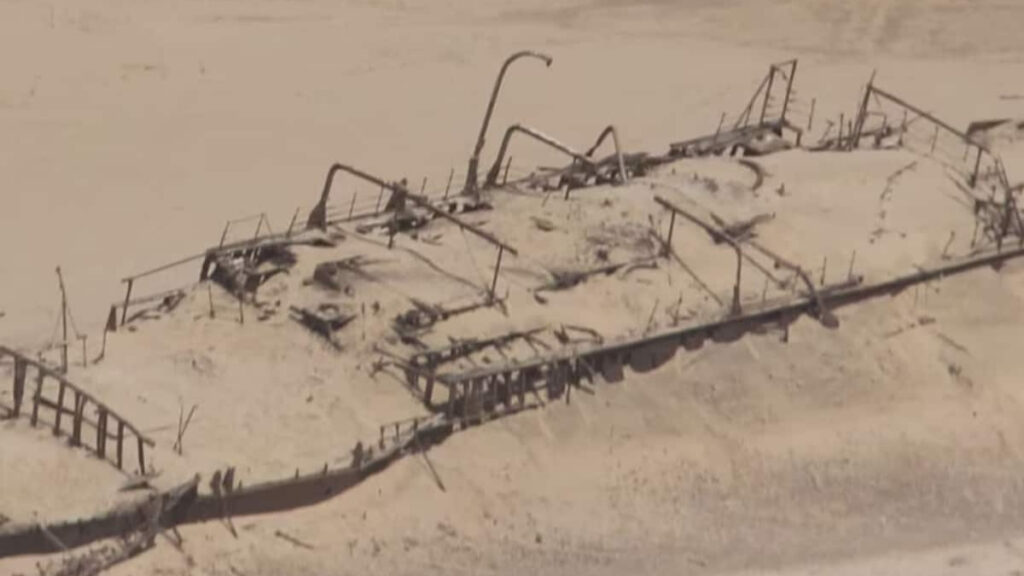
In 2008, diamond miners uncovered the Bom Jesus, a 16th-century Portuguese shipwreck near Oranjemund, Namibia, loaded with gold coins, copper ingots, and ivory. Explore its history, cargo, and insights into Age of Discovery trade.
A 16th-century Portuguese merchant ship, identified as the Bom Jesus, lies buried miles inland in Namibia’s Namib Desert after sinking off the Atlantic coast nearly 500 years ago. Discovered in 2008 during diamond mining near Oranjemund, the wreck reveals details of early global trade networks during Portugal’s maritime expansion. Its well-preserved cargo offers a rare snapshot of Renaissance-era commerce.
Discovery in the Desert
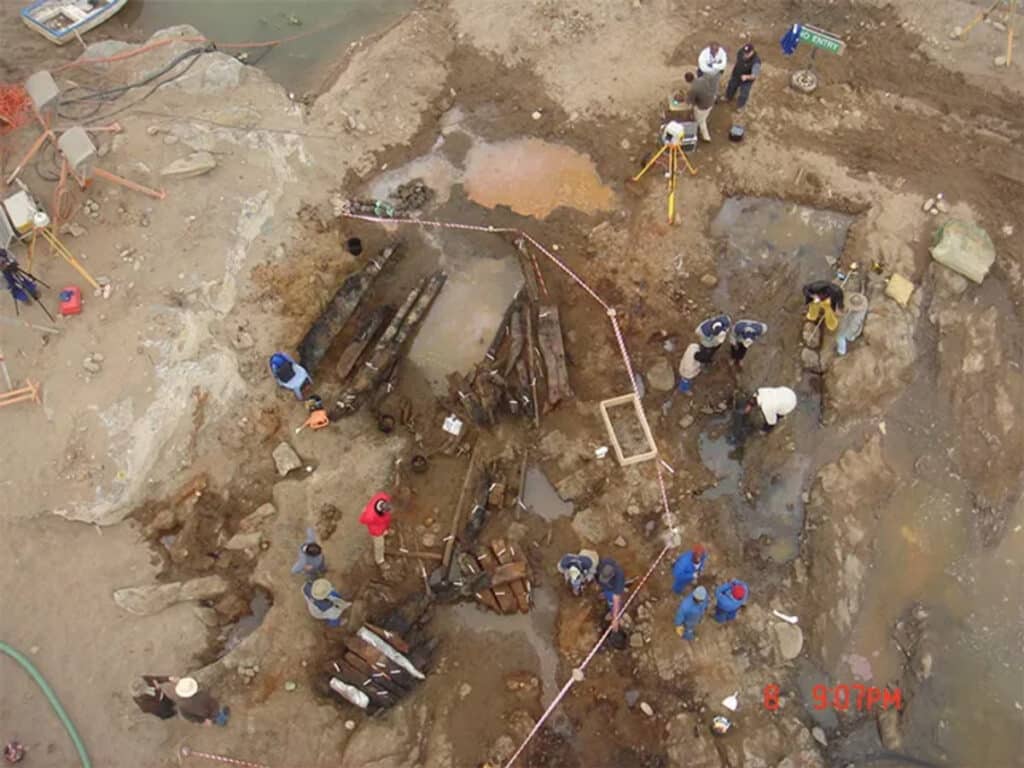
Diamond miners from Namdeb, a joint Namibian-De Beers operation, found the wreck on April 1, 2008, while draining seawater from a coastal site at coordinates 28°35′58″S 16°23′51″E. Archaeologist Dieter Noli, on-site for the company, identified ancient copper ingots and elephant ivory, prompting excavations with experts like Bruno Werz and Portuguese teams led by Francisco Alves. The site’s three scattered hull sections, protected by a moist, concretion layer from seawater-rich sand, yielded over 40 tons of artifacts without scavenger interference due to the secure mining zone.
Voyage and Sinking
The Bom Jesus, a nau (also called carrack), departed Lisbon on March 7, 1533, under captain D. Francisco de Noronha as part of a seven-ship fleet bound for India via Africa’s southern tip—the Carreira da Índia route opened by Vasco da Gama in 1497-1499. Loaded for Asian markets, it carried trade goods like copper for weapons and gold for spices. A violent storm likely drove it ashore near Oranjemund, where it struck a reef, capsized, and broke apart; shifting sands and tides buried it inland over centuries.
Cargo and Artifacts
Excavators recovered 2,159 coins (mostly Spanish excelentes and doblas, plus Portuguese cruzados), 1,845 hemispherical copper ingots (16-17 tons) stamped by the Fugger family of Augsburg, 105 elephant tusks (nearly 2 tons) from West African forest and savanna herds, plus cannons, swords, muskets, tin, lead, textiles, and navigation tools. Genetic analysis of the ivory confirmed origins near Portuguese forts like those in Benin, processed via Cape Verde and São Tomé. No human remains were found beyond fragments, suggesting crew survival or prior drowning.
Historical Significance
The wreck, Sub-Saharan Africa’s oldest identified shipwreck, illuminates Portugal’s dominance in 16th-century trade, linking Europe, Africa, and Asia with commodities like Fugger copper from Slovak mines and African ivory for Indian markets. It predates most known India Run wrecks and highlights carrack design advancements for long voyages, amid risks from storms on the Skeleton Coast—a notorious graveyard for ships. Ownership transferred to Namibia, with artifacts conserved in Windhoek vaults and on-site tanks.
What We Know vs. What’s Uncertain
Known: Departure date, fleet, probable route and sinking mechanism, full cargo catalog (e.g., coin types, ingot origins via stamps and geochemistry), ivory DNA/isotope profiles, hull scantlings (iron spikes, lead caulking like later wrecks).
Uncertain: Exact ship dimensions (no full reconstruction), wood species/dendrochronology (no samples taken), full crew fate (up to 200 aboard), precise identity confirmation (archives lost in 1755 Lisbon earthquake), final display plans (funding/permission issues delay museum transfer).
Update note suggestion: Last major analysis in 2016; ongoing conservation in Namibia. Check Namdeb or Namibian Heritage sites for 2025 excavation updates.