


Archaeologists in Muğla, Türkiye, have uncovered a 2,200-year-old silver necklace linked to the goddess Ishtar, revealing Amos’s role as a key cultural and commercial hub connecting the Near East and the Mediterranean.
High above the coast of southwestern Türkiye, archaeologists working at the ancient city of Amos have uncovered a silver necklace that offers more than aesthetic appeal. Decorated with a lion figure and an eight-pointed star, the ornament is believed to reference Ishtar, the powerful goddess of war, fertility, and authority in Mesopotamian belief systems.
Though modest in size, the object underscores Amos’s role as a cultural and commercial bridge between the Near East and the Mediterranean more than two millennia ago.
Where the discovery was made
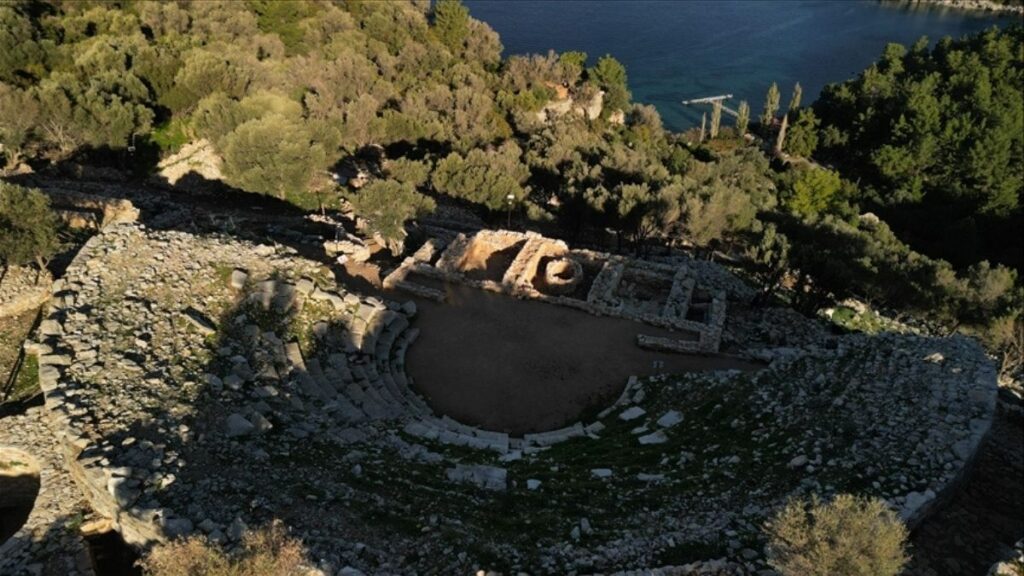
Amos sits on Asarcık Hill, overlooking the Gulf of Marmaris in modern Muğla Province. Archaeological evidence suggests the city flourished during the Hellenistic period, when maritime trade tied Anatolia to the Aegean, the Levant, and beyond.
Excavations have been ongoing throughout 2025, led by Mehmet Gürbüzer of Muğla Sıtkı Koçman University, under Turkey’s Heritage for the Future Project, coordinated by the Ministry of Culture and Tourism.
The necklace and its symbolism
The silver necklace dates to approximately the 3rd century BCE, around 2,200 years ago. Its iconography is particularly striking:

Lion motif: A long-standing symbol of divine authority and protection
Eight-pointed star: Widely associated with Ishtar (known earlier as Inanna in Sumerian tradition)
Ishtar’s cult spread far beyond Mesopotamia, reaching Anatolia through trade networks, diplomacy, and military contact by at least the 7th century BCE. The presence of her symbols at Amos suggests familiarity with — and possibly reverence for — Near Eastern religious ideas alongside Greek traditions.
Why Amos mattered in antiquity
Amos was not a major imperial capital, but archaeology increasingly points to its strategic importance:
Its location allowed control over coastal routes between Caria, Rhodes, and the wider Aegean
Trade likely brought luxury goods, religious ideas, and artistic styles from the Near East
Earlier discoveries, including inscribed lease contracts, reveal an organized economy and literacy

The necklace strengthens the view that Amos was not culturally isolated, but actively engaged with the wider ancient world.
Religion at the crossroads
The city is also known for the Temple of Apollo Samnaios, highlighting its Greek religious identity. The appearance of Ishtar symbolism does not contradict this; instead, it reflects the religious pluralism common in port cities.
In the ancient Mediterranean, divine imagery often traveled more freely than political borders, blending local and foreign traditions.
What we know vs. what’s uncertain
What we know
The necklace is made of silver and dates to around 2200 years ago
Its symbols strongly resemble Ishtar’s iconography
Amos was an active trade and cultural center during the Hellenistic period
Excavations confirm long-term habitation and economic organization
What remains uncertain
Whether the necklace was locally produced or imported
If it belonged to a resident, merchant, or ritual context
Whether Ishtar was actively worshipped in Amos or referenced symbolically
How widespread Near Eastern religious influence was among the city’s population

A site still revealing its story
Amos was first excavated in 1948 by British archaeologist G.E. Bean, but systematic research expanded only in recent decades. Officially recognized as a protected archaeological site in 2022, it remains under active study.
Excavations are planned to continue in 2026, with attention shifting to residential areas and further investigation of sacred architecture.
Each season adds detail to a broader picture: Amos as a node of exchange, where ideas, goods, and beliefs converged.
Why this discovery matters
The necklace does not rewrite history on its own, but it refines our understanding of how ancient societies interacted. It shows that even smaller cities participated in global networks of the ancient world — absorbing influences, adapting symbols, and shaping shared cultures.
In archaeology, such objects remind us that connectivity is not a modern invention.