


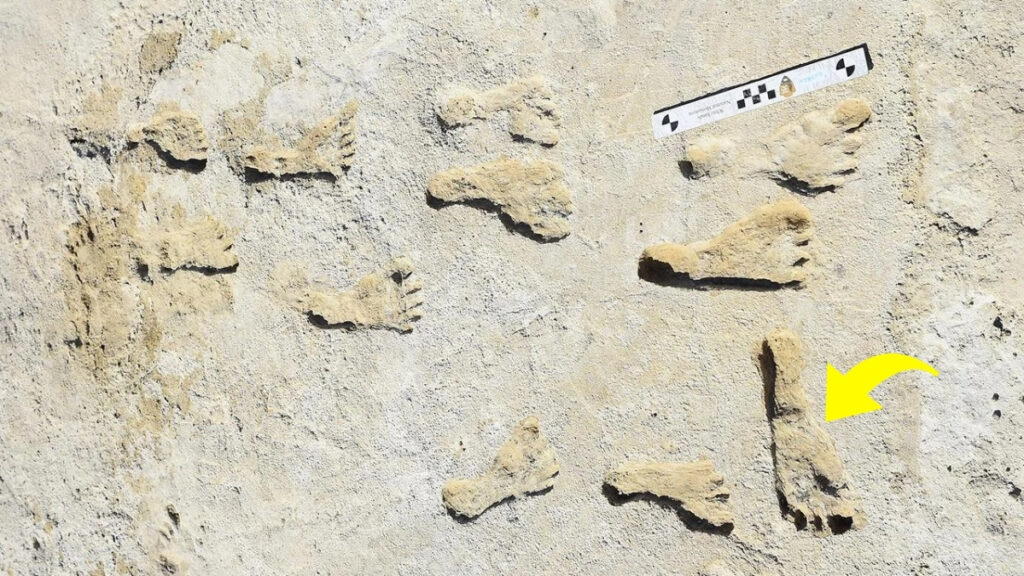
Imagine a scene 800,000 years ago. A small band of early humans trudges across a vast, muddy estuary in what is now eastern England. The air is cool but not frigid. They are far, far north of their ancestral homeland. Behind them, the fleeting impressions of their feet are left in the silt.
Then, imagine those same footprints emerging from the sand today, exposed for a few brief hours by the brutal North Sea tides before being erased forever.
This is not a cinematic fantasy. It is a revolutionary archaeological reality. On a storm-battered beach in Norfolk, scientists have documented the oldest human footprints ever discovered outside of Africa. This is not merely a discovery of ancient bones or stone tools. This is a direct, intimate snapshot of a single day almost a million years ago. It is a ghostly echo of a journey that fundamentally reshapes our understanding of human courage, migration, and survival in a forgotten era.
The Astonishing Find: A Race Against the Tide
The location is Happisburgh (pronounced Haze-burra), a coastline notorious for its rapid and dramatic erosion. Each storm scours away cliffs, revealing secrets buried for epochs. In May 2013, after particularly heavy seas, a team from the British Museum and Queen Mary University of London noticed unusual hollows on the exposed foreshore.
The Revelation in the MudThe markings were not random. They formed clear, sequential hollows. The team’s hearts raced. They immediately recognized the potential for a once-in-a-lifetime discovery. But they were in a desperate race. The sea would return within hours, scouring the soft sediments clean.
Capturing a Vanishing ActDeploying rapid-response digital archaeology, the team used multi-image photogrammetry. They took hundreds of overlapping photographs from every angle. From these, they built a precise, three-dimensional digital model of the entire surface. This digital record, now stored forever in cyber-space, is all that remains. Just days later, the waves had completely destroyed the original footprints. The ancient moment was glimpsed, then lost again to time.
Decoding the Ghostly Imprints: Who Were They?
The high-resolution 3D models revealed mind-blowing details. At least five individuals left their mark. Analysis of the foot sizes and stride patterns told a profound story.
A Family Group on the MoveThe footprints ranged dramatically in size. Researchers identified prints from adults, likely both male and female. Most poignantly, they found the small, clear prints of children. This was not a hunting party. This was likely a family group—a small community moving together across the landscape. The orientation of the tracks suggests they were walking south, possibly following the river inland or moving toward a known resource.
The Prime Suspect: Homo antecessorWho were these early pioneers? While no human fossils were found at this exact level, the timeline points to one species: Homo antecessor, or “Pioneer Man.” This species is known from spectacular fossil finds at Atapuerca in Spain, dating to a similar period. Homo antecessor possessed a blend of modern and archaic features and was a skilled toolmaker and hunter.
The Happisburgh footprints provide the physical proof of their staggering journey. They had traversed an entire continent, reaching latitudes much further north than ever previously imagined for humans of this antiquity.
Scientists Just Cracked the Pyramid Code: A “Forgotten Force” Built Egypt’s Wonders
Global Implications: Redrawing the Map of Human Migration
This discovery is not just a British headline. It is a global historical correction with seismic implications.

Surviving the Northern FrontierFor decades, the prevailing theory held that early humans were confined to the warm, Mediterranean climates of southern Europe until about 500,000 years ago. Happisburgh shatters that timeline. It proves that human groups, with children in tow, were resilient enough to survive in the cooler, more challenging environments of northern Europe nearly 300,000 years earlier.
Britain was not an island then. It was a peninsula of continental Europe, with a land bridge connecting it to what is now the Netherlands. The Happisburgh group walked there from lands far to the south and east.
A Lost World RevealedThe footprint layer is part of the rich “Happisburgh Site,” which has also yielded simple flint tools and a wealth of environmental data. We know they shared this cool, damp landscape with mammoths, early forms of bison and horse, and even saber-toothed cats. The presence of children indicates they weren’t just brief explorers. They were settling in, learning the rhythms of this northern world.
What This Means for History: A Paradigm Shift
The Happisburgh footprints are a touchstone to a past so deep it defies easy imagination. They move the narrative of human expansion from abstract theories of stone tools to a tangible, heartbreakingly human story.
This discovery forces a complete reconsideration of the pace, route, and adaptability of the first human migrations into Europe. It suggests that these ancient relatives were far more versatile, adventurous, and capable than we credited them for. They were not clinging to the familiar south; they were pioneers in every sense, pushing into new ecological niches and laying the groundwork for all future human history on the continent.
They are a powerful reminder that history is not just found in grand monuments and golden treasures. Sometimes, the most profound connection to our past is found in the simple, muddy impression of a child’s foot, a silent testament to a family’s journey under an ancient sun.

5 In-Depth FAQs
1. How were the footprints dated so precisely?The footprints themselves cannot be directly dated. Their age was determined by their stratigraphic position. They were found within the “Hill House Formation,” a known geological layer. This layer sits beneath glacial deposits and above a magnetic reversal boundary known as the Matuyama-Brunhes boundary (dated to 780,000 years ago). Combining this with biostratigraphy—studying the extinct animal fossils and pollen in the same sediments—allowed scientists to pinpoint the age to around 800,000 years, during a warm interglacial period.
2. Why are no human bones found with the footprints?Fossilization of bones requires very specific, rapid burial in mineral-rich environments. The estuary mud at Happisburgh was likely acidic and active, conditions that lead to the decay of organic material. Stone tools, made of inert flint, and footprints, which are essentially geological molds, have a much higher preservation potential in such settings. The extreme rarity of human fossils from this period across all of Europe makes the footprint evidence even more critical.
3. What does this discovery mean for the “Out of Africa” theory?It fully supports and enriches it. The “Out of Africa” theory describes multiple waves of human migration from the African continent. Happisburgh provides the earliest concrete evidence for one of the first major waves into northwestern Europe. It confirms that these early migrations reached far greater geographic extremes much earlier than the archaeological record previously showed.
4. Could the footprints belong to another primate, like Homo neanderthalensis?No. Neanderthals (Homo neanderthalensis) did not evolve until much later, around 400,000 years ago. The 800,000-year date places these footprints firmly in the era of earlier human species like Homo antecessor or perhaps a related, yet-to-be-identified species. The anatomical proportions of the footprints, where discernible, are consistent with early humans and not with other primates.

5. Is coastal erosion, which revealed the site, now a threat to other finds?Absolutely. Coastal erosion at Happisburgh is a double-edged sword. It reveals incredibly important archaeological layers that would otherwise remain hidden deep underground. However, it then immediately destroys them. This creates an urgent “rescue archaeology” scenario. Scientists are in a constant battle with the sea to digitally document and recover any material exposed by the storms before it is lost forever. The Happisburgh footprints are the most dramatic example of both the opportunity and the immense loss posed by our changing coasts.