


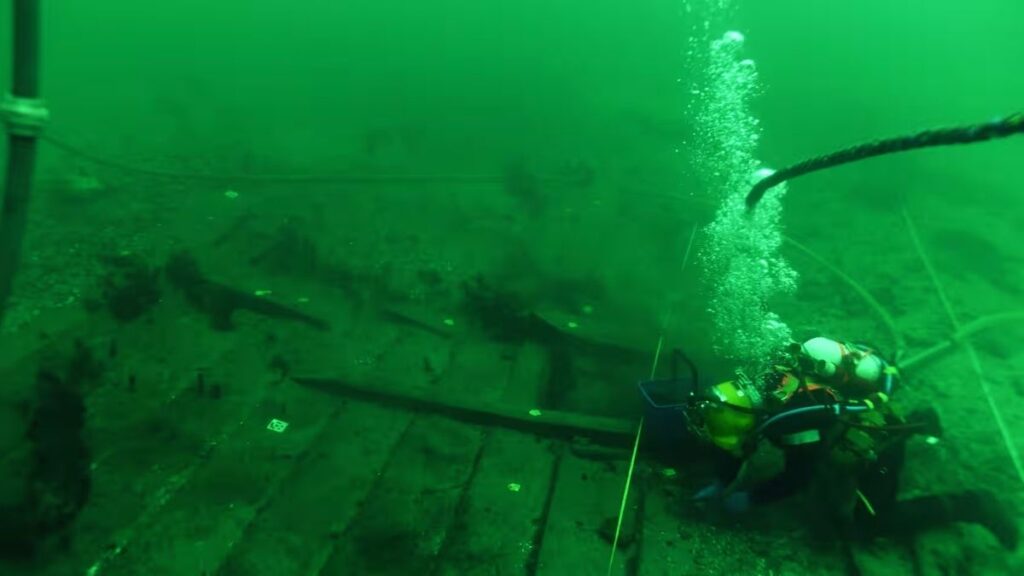
Marine archaeologists working in the waters between Denmark and Sweden have identified an extraordinary shipwreck as the largest medieval cog ship ever discovered. Resting on the seabed of the Øresund Strait for roughly six centuries, the vessel—known as Svælget 2—represents a scale of cargo transport previously undocumented in archaeological records. Researchers estimate that the ship could carry up to 300 tons of goods, placing it in a category comparable, in its own era, to today’s largest commercial cargo ships.
The wreck lies about 13 meters below the surface, off the coast of Copenhagen, where it remained largely undisturbed since the 15th century. The investigation has been led by specialists from the Viking Ship Museum in Roskilde, including maritime archaeologist Otto Uldum, who described the find as a rare opportunity to study medieval large-scale trade vessels in near-complete form. Danish historian Cecilie Nielsen, speaking to broadcaster DR, likened its economic role to that of modern container ships—massive, utilitarian platforms designed to move goods efficiently rather than impress visually.
An Unusually Complete Medieval Ship
Recovering Svælget 2 was a demanding and prolonged effort. Over 289 professional dives, spread across more than two and a half years, archaeologists carefully documented and excavated the wreck. Unlike most medieval cogs—often discovered fragmented or heavily eroded near coastlines—this vessel survived in remarkable condition.
Its preservation is largely due to the way it sank. The ship settled on its side in deeper water, shielding large portions of the hull from destructive currents and biological activity. As a result, researchers were able to examine structural elements from the keel up to the deck, a level of completeness rarely achieved for ships of this period.
Excavations also revealed remains of both a forecastle and aftcastle, small enclosed structures that offered shelter to crew members. Such features are poorly documented archaeologically and provide valuable insight into working conditions aboard late medieval merchant ships. Alongside structural remains, everyday items—including footwear, a wooden comb, cooking equipment, and serving trays—were recovered, offering tangible evidence of daily life at sea.
Built for the Expanding Medieval Economy
Cog ships were the backbone of Northern European trade during the later Middle Ages. Their broad hulls, shallow draft, and relatively simple rigging made them ideal for transporting heavy loads across coastal and open waters with modest crew sizes. Svælget 2 exemplifies this design philosophy at its most extreme.
Dendrochronological analysis shows that the ship was built using planks sourced from present-day Poland, while its internal framing came from Dutch timber, underscoring the interconnected nature of European trade networks even at the level of raw materials. The vessel measured approximately 28 meters in length, nine meters in width, and around six meters in height, dimensions that exceed those of all previously known cog finds.
According to Uldum, the ship illustrates a crucial transition in medieval commerce: a move away from small shipments of luxury items toward the bulk transport of everyday goods such as construction materials, agricultural produce, and fuel. This shift supported urban growth and regional specialization across Northern Europe.
A Ship Optimized for Profit, Not Longevity
Detailed study of the hull revealed that Svælget 2 was not built to last for decades. Many of its planks were of average quality, and some show signs of cracking that likely occurred during construction. Rather than reflecting poor craftsmanship, archaeologists interpret this as evidence of economic pragmatism.
By the 15th century, merchant shipping had become a highly organized business. Ships were often expected to recover their construction costs within one or two voyages, after which continued operation was pure profit. Financing systems, shared ownership, and predictable trade routes reduced risk, allowing builders to prioritize capacity and speed over durability.
In this context, Svælget 2 stands as a physical record of medieval capitalism in action—an industrial tool rather than a prestige object.
Insights into Life and Power in the Øresund
Beyond economics, the ship provides rare cultural insights. A stone-lined hearth discovered onboard indicates that the crew prepared hot meals during voyages, a feature seldom preserved in medieval shipwrecks. This detail suggests longer journeys and more complex onboard routines than often assumed.
The vessel likely operated during the era of Queen Margrethe I, when control of the Øresund was central to Scandinavian political power and trade regulation. Goods passing through these waters were subject to tolls and oversight, making the strait one of the most strategically important maritime corridors in medieval Europe.
For Denmark, the discovery reinforces the country’s historical role as a maritime gateway linking the Baltic and the North Sea—an economic position whose influence persists today.
What We Know vs. What’s Still Uncertain
What We Know
Svælget 2 dates to the early–mid 15th century
It is the largest cog ship yet identified archaeologically
The vessel could carry approximately 300 tons of cargo
Construction materials originated from multiple European regions
The ship was designed for bulk commercial trade
What’s Still Uncertain

The ship’s exact trade routes and final voyage
The specific cargo it carried when it sank
Whether it was state-affiliated or privately owned
The precise cause of its sinking
Researchers emphasize that future analysis may refine or revise these interpretations as conservation and study continue.
Conservation, Exhibition, and Public Access
Following excavation, the wreck was transferred to the National Museum of Denmark in Brede, where it is undergoing long-term conservation. In parallel, the Viking Ship Museum in Roskilde has opened a dedicated exhibition focusing on marine archaeology and the recovery of Svælget 2.
The dramatic lifting of the ship—including the moment its keel was carefully cut to allow recovery—was documented in the DR television series Gåden i Dybet (“The Mystery in the Deep”), offering the public an unprecedented look at the challenges of underwater archaeology.
Why This Discovery Matters
Svælget 2 is more than an unusually large shipwreck. It represents a turning point in how goods moved, economies functioned, and maritime technology evolved in medieval Europe. By revealing the mechanics of large-scale trade centuries before industrialization, the ship helps bridge the gap between medieval commerce and modern global logistics.
As research continues, this silent giant from the Øresund promises to reshape how historians understand everyday trade in the Middle Ages—and how closely it resembles the systems we rely on today.