Imagine holding a book that has defied every expert on Earth for over a century.
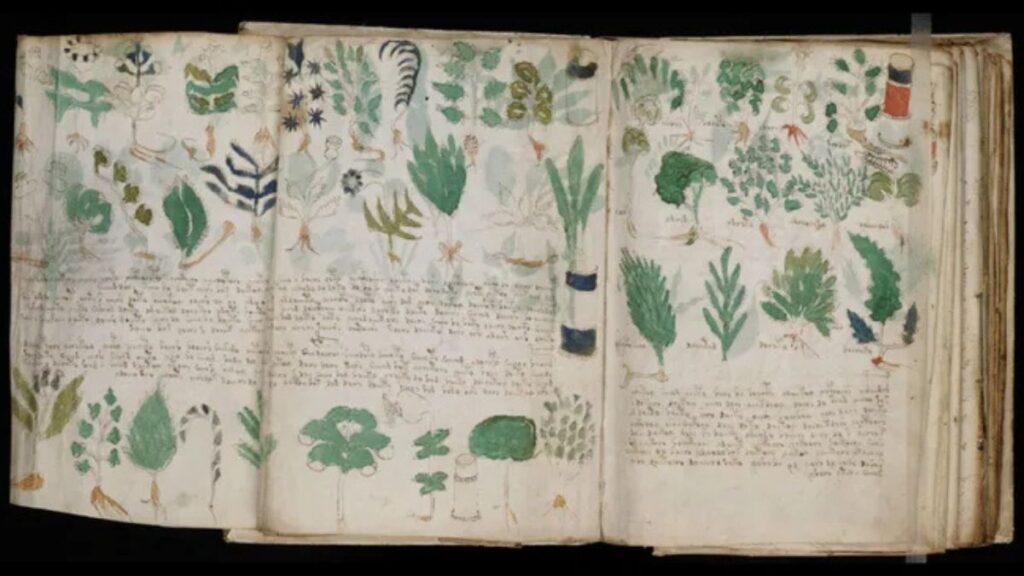
Its pages are filled with bizarre, unearthly plants. Cryptic astrological charts. And strange, naked women bathing in a vivid green liquid. But the true mystery isn’t the images. It’s the text.
38,000 words written in a script unknown to any civilization. A language that has resisted codebreakers, AI supercomputers, and the greatest linguistic minds of our time.
This is the Voynich manuscript. And a revolutionary new study now suggests its secret may not be a lost language, but a clever medieval game.
The Astonishing Find
The Unreadable Book
The Voynich manuscript is archaeology’s greatest ghost. Carbon-dated to the early 15th century, its origin and purpose are complete blanks.
It was rediscovered in 1912 by rare book dealer Wilfrid Voynich. He found it in a Jesuit college near Rome. Since then, it has passed through the hands of scholars and collectors, eventually finding a permanent home at Yale University’s Beinecke Rare Book & Manuscript Library.
Yet, its home provides no answers. The vellum pages whisper only in indecipherable glyphs.
A Century of Failed Secrets
The 20th and 21st centuries brought wave after wave of attempted decipherment. World War II codebreakers fresh from cracking the Enigma machine took up the challenge. They failed.
Modern computational linguists and artificial intelligence have thrown immense power at the puzzle. They have found statistical patterns but no meaning.
This relentless failure fueled a dark theory. What if the manuscript is an elaborate, meaningless hoax? A medieval forgery designed to baffle and fetch a high price from a gullible noble?
But the patterns in the text are too consistent. Too complex. The debate has raged: profound secret or brilliant fraud?
The Revolutionary Cipher
The “Naibbe” Breakthrough
Enter a groundbreaking new study published in the journal Cryptologia. Science journalist and researcher Michael Greshko has proposed a stunning new mechanism.
He calls it the “Naibbe” cipher. Named after a 14th-century Italian card game, it uses everyday objects: dice and playing cards.
Greshko asked a simple, brilliant question. How would a clever mind in the 1400s create a complex, pseudo-language using only the tools at hand?
How the Medieval Machine Works
The cipher’s elegance is mind-blowing. First, a writer would take a passage in a known language, like Latin or Italian.
A roll of a die would determine how to break the words into pieces. Then, the draw of a playing card would select one of six different cipher tables. These tables convert the letter fragments into strange, Voynich-like glyphs.
Crucially, the card draws weight the tables. This means some glyphs appear more often than others. The result? The artificial text perfectly mirrors the bizarre statistical properties of the real Voynichese.
For the first time, someone has created a “Voynich-like” text using purely 15th-century technology.
What the Artifacts Reveal
Eerily Perfect Mimicry
The output of the Naibbe cipher is uncanny. It doesn’t decode the Voynich. But it replicates its soul.
The synthetic text matches the manuscript’s word length distribution. It copies the mysterious “grammatical” rules seen in the glyph sequences. Most importantly, it replicates the unique statistical fingerprint of the symbols.
This is a monumental shift. It proves that a complex, consistent, and seemingly linguistic text could be generated without holding a single, coherent meaning.
The Hoax Hypothesis Strengthened
Greshko is cautious. He does not claim the Naibbe cipher is the exact method used. But he has provided a fully documented blueprint.
It demonstrates how a single individual, with patience and a clever system, could have manufactured the entire mysterious text. The study adds powerful, empirical weight to the hoax theory.
The bizarre illustrations of unknown plants and bathing nymphs? They could be part of the ruse. A sensational visual package to sell an even more sensational “book of secrets.”
Global Implications
A Benchmark for Mystery
This research changes the game for all future Voynich studies. Greshko hopes his cipher will become a computational benchmark.
Scientists can now compare the real manuscript against the Naibbe output. The points where they differ are now the new frontier.
Those discrepancies may hide the truth. They could be the fingerprints of the true method. Or they could be the subtle clues that prove a real language is, in fact, buried beneath the code.
Redefining Historical Cryptography
The study forces a global reevaluation of medieval ingenuity. We often underestimate the cryptographic sophistication of the pre-digital age.
The Voynich manuscript may not be a gateway to lost alchemy or alien botany. Instead, it could stand as a testament to a forgotten art of constructing artificial mystery.
It represents a different kind of secret. One of human creativity and deception, rather than hidden planetary knowledge.
What This Means for History
The Voynich manuscript has captivated the worldwide public for generations. It symbolizes the ultimate unsolved puzzle.
This new cipher theory doesn’t rob it of its power. It transforms its story.
If a hoax, the manuscript becomes a breathtaking artifact of human psychology. A mirror showing our endless desire to find meaning, even where none exists. It reflects the lucrative economy of secrets in Renaissance Europe.
If the blueprint for a more complex cipher, it provides the first real mechanical key in 600 years.
The search is not over. It has simply entered a new, electrifying phase. The manuscript remains in its vault at Yale. Its strange, beautiful pages continue to challenge us.
They ask not just “Can you understand me?” but a deeper question: “How far will you go to solve a mystery that might not be there?”
In-Depth FAQs
- How was the Voynich manuscript discovered?
The manuscript entered the modern historical record in 1912. Polish rare book dealer Wilfrid Voynich purchased it from the Jesuit Collegio Romano (near Rome). He found it among a trunk of books the Jesuits were selling to fund their operations. Its history before that is murky, hinted at in vague letters, but never confirmed. - Has anyone ever credibly deciphered it?
No credible, peer-accepted decipherment exists. Numerous claims have been made over the decades, proposing everything from corrupted Ukrainian to a universal Asian language. None have withstood scholarly scrutiny or been able to consistently translate large, meaningful sections of the text. - What do the illustrations actually show?
The illustrations are famously bizarre. The “herbal” section shows plants that do not match any known species. The “astronomical” section features unusual zodiac-like diagrams. The “biological” section shows networks of pipes and naked women bathing in interconnected green pools. Their purpose remains the core of the mystery. - Why can’t modern computers and AI break the code?
Advanced AI has identified patterns, rules, and structures within the text. This proves it is not random gibberish. However, AI cannot determine if these patterns encode a language or were generated by a procedural cipher (like Naibbe). It is the fundamental difference between finding patterns and finding meaning. - What’s the next step for researchers?
The Naibbe cipher provides a new testable model. Scholars will now analyze the precise differences between its output and the actual manuscript. They will also search historical records for any mention of similar cipher techniques. The goal is to either refine the mechanical model or use the discrepancies to finally isolate a genuine underlying language.