



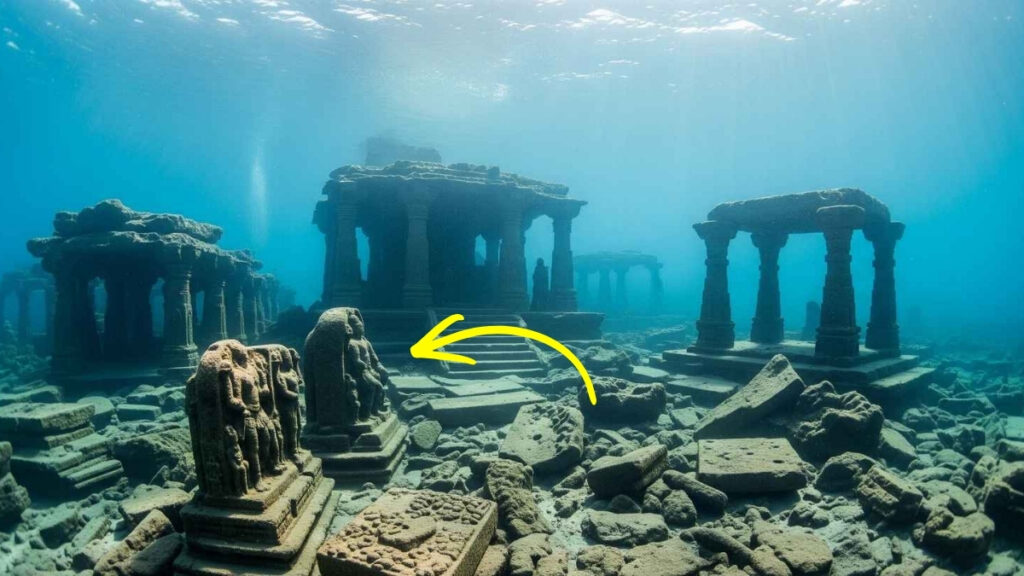
What if a city of myth, described in sacred texts for millennia, suddenly emerged from the fog of legend? Not as a metaphor, but as stones and foundations on the ocean floor.
For thousands of years, the tale of Dwarka—the glorious, fortified capital of Lord Krishna—was a spiritual cornerstone. Ancient scriptures told of its divine construction, its immense wealth, and its tragic fate: swallowed by the sea after Krishna’s departure from the mortal world .
For centuries, it was considered a powerful allegory. Then, marine archaeologists turned their sonar towards the waters off modern-day Gujarat. What they found has sparked a revolution, blurring the line between ancient faith and verifiable history. This is the story of the search for a sunken kingdom .
The Legend: A Celestial City Lost to the Waves
In texts like the Mahabharata and Bhagavata Purana, Dwarka is described in breathtaking detail. It was a city of 900,000 palaces adorned with silver and crystal, with high buildings that nearly touched the sky .
Lord Krishna is said to have built this “Gateway to Heaven” on land reclaimed from the ocean. It became the epicenter of his divine exploits and a bastion of the Yadava clan. Its end was prophesied. Following Krishna’s death, the scriptures recount a catastrophic event where the sea violently breached its boundaries, consuming the entire metropolis in a matter of moments .
This dramatic submergence left behind only a memory, a story passed down through generations. Until modern exploration began to ask: was it just a story?
The Astonishing Find: Archaeology Beneath the Arabian Sea
The turning point came in the 1980s. Pioneering archaeologist Professor S.R. Rao initiated systematic underwater searches off the coast of Dwarka .

His team made a mind-blowing discovery. Submerged just half a kilometer from the present shore, they found the remains of a well-organized settlement. This was not a random scattering of rocks. They uncovered massive stone blocks forming fortifications, geometric walls, and even a structure identified as a “water fort” or VaariDurg mentioned in the ancient texts .
The evidence pointed unequivocally to a major, planned urban port that met a sudden end. The most compelling finds were not grand palaces of gold, but the pragmatic infrastructure of a thriving city.
What the Artifacts Reveal: A Snapshot of a Living Port
The seabed yielded tools of daily life and commerce that anchored Dwarka firmly in the historical timeline. Archaeologists recovered stone molds for crafting weapons, iron implements, and copper utensils .
Crucially, they found pottery. Specific pottery sherds were directly linked to the Late Harappan era, a cultural phase of the ancient Indus Valley Civilization. This provided the first tangible clue to the city’s age .
Perhaps the most definitive evidence of maritime activity was the discovery of stone anchors. Some were colossal, weighing up to 560 kilograms. Their three-holed design was strikingly similar to anchors used in distant ports like Cyprus and Syria around 1500-1200 BCE, placing Dwarka squarely within an extensive Bronze Age trade network .
Dating the Deluge: Science Enters the Epic
The critical question remained: When did this city exist? Scientific analysis moved the narrative from speculation to chronology.
Radiocarbon dating of artifacts, including wooden remains and pottery, yielded stunning results. The data suggests the submerged settlement dates back to roughly 1500–1700 BCE .

This timeframe is revolutionary. It places a city described in Hindu epics to the very end of the Indus Valley Civilization period. It suggests cultural and urban continuity in the region, bridging the gap between the great Indus cities and the later historical periods of India.
The discovery implies Dwarka was not a standalone myth but potentially a powerful, historical port city whose memory was preserved and magnified in epic poetry for over 3,500 years.
The Great Submergence: Geology vs. Legend
How did a thriving city end up under the sea? The ancient texts describe a sudden, apocalyptic flood. Modern geology suggests a slower, but no less dramatic, process.
The Gujarat coastline is geologically active and prone to subsidence—a gradual sinking of the land. Recent satellite studies using advanced radar show parts of the Gujarat shore are still sinking today at rates exceeding 5 mm per year, with some areas subsiding over 15 mm annually .
This process, compounded by rising sea levels after the last Ice Age, likely doomed ancient Dwarka. The submergence probably occurred in phases over centuries. A major storm or tsunami, coinciding with this ongoing subsidence, could have inspired the legend of a single, cataclysmic event .
The science confirms the core truth of the tradition: the land here was claimed by the ocean.
Global Implications: Rewriting the Ancient World Map
The implications of Dwarka extend far beyond Indian shores. This discovery challenges old paradigms. It presents hard evidence of a sophisticated, maritime urban culture in India contemporaneous with late Bronze Age powers in the Mediterranean and Mesopotamia.
The distinct stone anchors suggest Dwarka was a nexus in a vast, interconnected ancient world. Goods, ideas, and technologies likely flowed between the Indian subcontinent, the Arabian Peninsula, and beyond.
It forces historians to reconsider the dynamics of ancient trade. The Indian Ocean was not a barrier but a highway, and Dwarka was one of its major ports.
The Hunt Continues: New Light on an Ancient Mystery
The story is far from over. In 2025, the Archaeological Survey of India (ASI) launched a new, high-tech underwater expedition to Dwarka and nearby Bet Dwarka island .
This mission employs advanced scientific analysis of sediments and marine deposits. The goal is to build a more precise timeline and understand the settlement’s full extent . This renewed official interest underscores Dwarka’s immense historical value.
Each dive has the potential to unlock new secrets. The ocean floor guards its mysteries closely, but modern archaeology is determined to bring them to the surface.
What This Means for History
Dwarka stands as a profound testament to the interplay of human memory and material history. Archaeology has not “proven the myth” in a literal sense—it has uncovered the historical reality that inspired it.
We now have compelling evidence that a significant, fortified port city existed at the exact location remembered in sacred tradition for millennia. It thrived during the epic era, traded across ancient seas, and was lost to the rising waves.

This discovery does not diminish the legend; it grounds its grandeur in a tangible, awe-inspiring past. Dwarka is a powerful reminder that some of humanity’s oldest stories are not mere fiction. They are echoes of real places, real events, and a lost world waiting to be rediscovered.
In-Depth FAQs: Your Questions Answered
1. How was the underwater city first discovered?Systematic discovery began in 1983 under archaeologist Prof. S.R. Rao. Using sonar surveys and underwater photography, his team mapped geometric structures and fortifications on the seabed, confirming the existence of a major submerged settlement .
2. What is the strongest evidence that this is the Dwarka from legend?The convergence is powerful. The site’s location matches ancient descriptions. The unearthing of a “water fort” (VaariDurg) aligns with texts. Most convincingly, the carbon dating of artifacts places a major port city at this exact spot during the very period (Late Harappan, ~1500 BCE) associated with the epic tradition .
3. How did the city end up underwater?Scientific evidence points to coastal subsidence—the gradual sinking of land—combined with rising post-Ice Age sea levels. This geological process, still active in Gujarat today, likely inundated the city in phases, possibly culminating in a major storm event that became enshrined in legend as a sudden cataclysm .
4. Are there ongoing excavations?Yes. As recently as 2025, the Archaeological Survey of India (ASI) launched a new underwater archaeology project at Dwarka and Bet Dwarka. This mission uses modern scientific techniques to analyze recovered artifacts and sediments, aiming to uncover more details about the city’s history and lifespan .
5. Why is this discovery important for world history?Dwarka reshapes our understanding of ancient maritime networks. Its existence as a major port around 1500 BCE demonstrates advanced Indian Ocean trade links contemporaneous with Mediterranean and Mesopotamian civilizations. It challenges the notion of isolated ancient cultures, revealing a more interconnected Bronze Age world .